
Kilimanjaro is one of the most incredible natural wonders in the world. In the middle of the African Savannah, the mountain rises to almost 6,000 meters, like a deity to be worshiped.
Classified by UNESCO as a World Heritage Site, the trek to reach its summit begins in a small forest at its base, passing through several rock formations until reaching an enormous and splendid glacier. As if so much natural diversity and beauty were not enough, the local team has a contagious smile and energy, always serving us with great joy, care and attention
Come and explore unique landscapes and learn about the culture of the hospitable Tanzanian people.
Discover the itinerary of this journey and adventure with us!
Tanzania
10 days
Medium
Day 1 – Arrival in Tanzania
A transfer will be waiting for you at the international airport and you will be taken to the hotel in Moshi, a transfer that takes around 1 hour. After settling in, the rest of the day will be dedicated to resting after the long journey.
Day 2 – Moshi
After breakfast, we will have a meeting to discuss the details of the rest of the trip. The day is reserved for exploring the region, strolling through the city streets and, if necessary, guidance will be provided on equipment rental. Free night.
Day 3 – Moshi to Machame and Machame Camp (3030m)
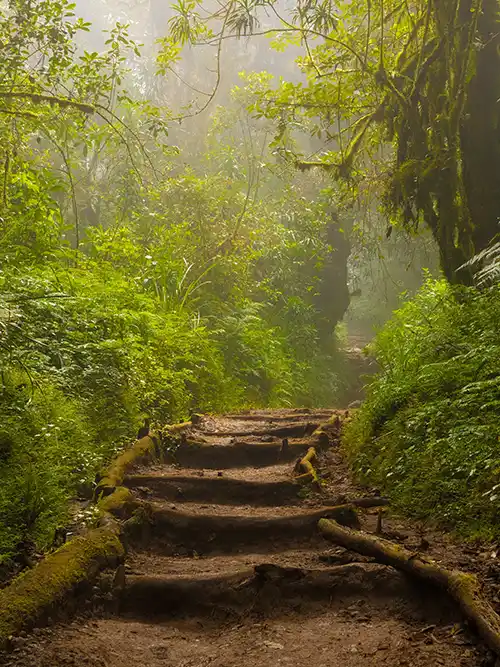
After breakfast, our adventure begins with the drive to Kilimanjaro National Park, where we will arrive at the Machame gate. After formalities and permits, we will begin our trek through the rainforest until we reach Machame Camp.
Distance: 11km
Walking time: 5 to 7 hours
Elevation: 1830m to 3030m = 1200 meters
Day 4 – Machame Camp to Shira Cave Camp (3850m)
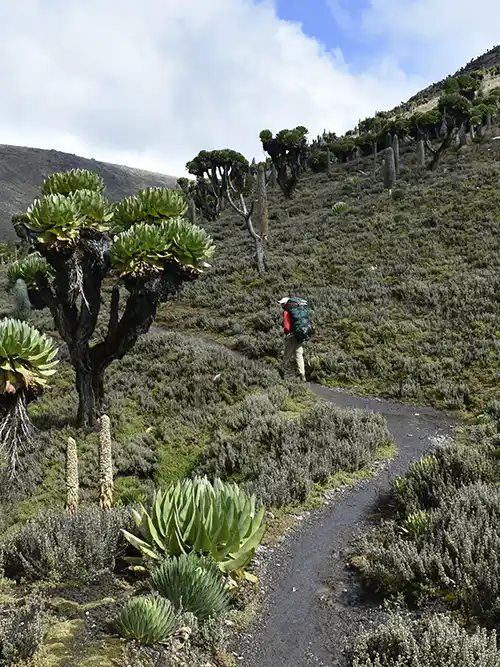
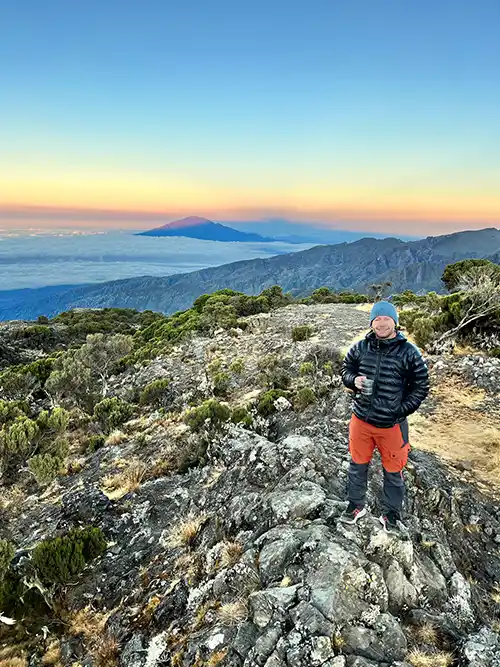
We continue climbing through the forest until we reach a steeper climb to the Shira Plateau. Looking back, you can see Mount Meru rising above Arusha city in the distance.
Distance: 5km
Walking time: 5 to 6 hours
Elevation: 3030m to 3850m = 820 meters
Day 5 – Shira Cave Camp to Lava Tower and Barranco (3985m)
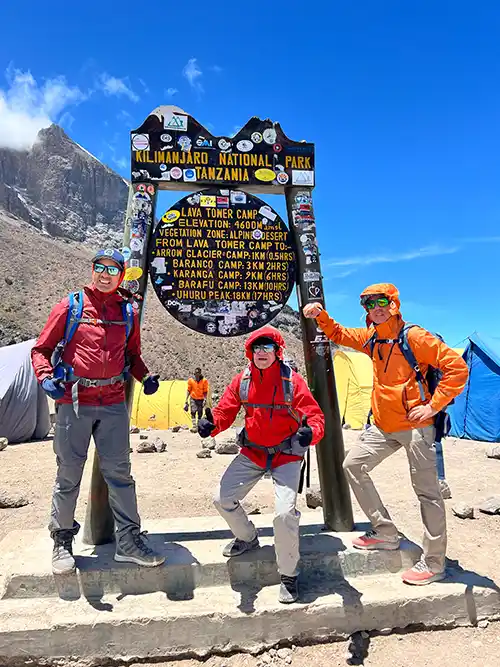
After breakfast we will start the trek to the Shira Plateau, where we will see the landscapes and formations known as the “cathedral” and “needles”. We will then continue east until we reach the Lava Tower, a vertical volcanic rock that stands at 4,600 meters. We will cross under the Lava Tower and descend to Barranco Camp, where we will sleep at an altitude of 3,985 meters for proper acclimatization.
Distance: 10 km
Walking time: 6 to 8 hours
Elevation: 3,850m to 4,640m to 3,985m = 790 meters
Descent: 655 meters
Day 6 – Barranco Camp to Karanga Camp (4,040m)
Our day begins with a descent and then we encounter a steep climb. Passing under the Heim and Kersten glaciers, we head towards the Karanga Valley. After reaching the camp and resting a little, we will do an acclimatization hike to an altitude of 4,200 meters and then descend for the night.
Distance: 5km
Walking time: 4 to 5 hours
Elevation: 3985m to 4040m = 55 meters
Day 7 – Karaga Camp to Barafu Camp (4680m)
After a good night’s rest and breakfast, we set off on our trek to Barafu Camp at 4680 meters. The climb will take us over desolate rocky slopes with no vegetation around us. It is a steep walk. We will reach the camp in the early afternoon. After breakfast we will have the afternoon to rest to prepare ourselves for a long night and day ahead. It is important to stay hydrated and warm. We have an early dinner and then try to get some sleep as we will leave between 11pm and midnight for the summit.
Distance: 4km
Walking time: 4 to 5 hours
Elevation: 4040m to 4680m = 640m
Day 8 – Barafu Camp – Uhuru Summit – Millennium Camp (3820m)
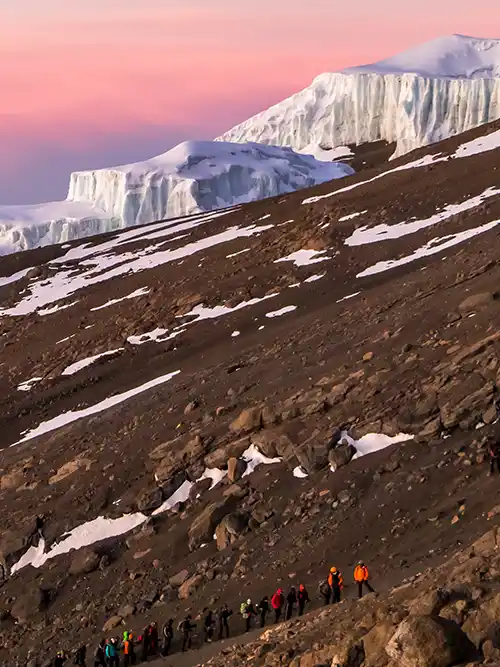
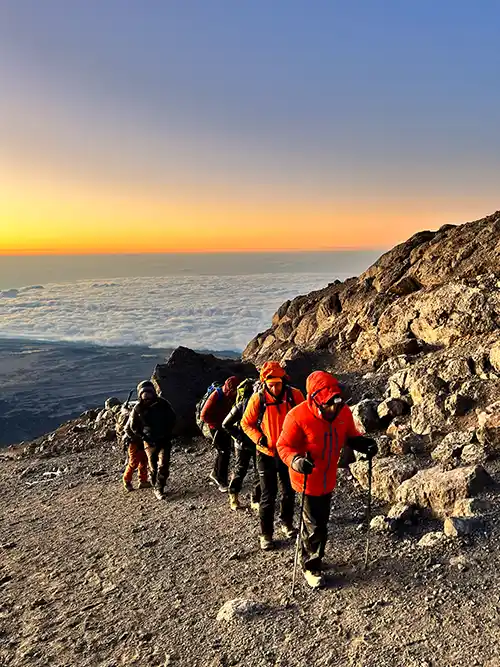
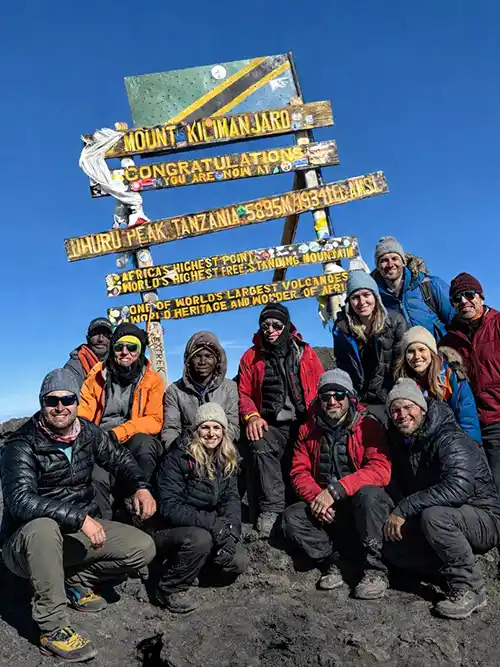
Around midnight we will start the walk to the summit near the glaciers. There will be a few hours of walking on the rocks, but we will gain incredible height in a short distance. The views are spectacular. We should be at the crater rim at Stella Point (5752m) when the first rays of the sun hit us. We will see spectacular ice cliffs inside the crater and the views towards the jagged peak of Mawenzi are breathtaking. After another hour of walking we will be at the summit, Uhuru Peak (5895m). After photos and celebrations, we will start our descent to Barafu Camp for breakfast, before finally descending to Millennium Camp for a well-deserved rest.
Distance: 16km
Walking time: 10-14 hours
Elevation: 4680m to 5895m = 1215 meters
Descent: 5895m to 3820m = 2075 meters
Day 9 – Millenium Camp to Mweka gate (1,700m)
A gentle walk takes us through the rainforest to Mweka Gate, where we complete the park formalities and proudly receive our certificates! We are then met by our vehicles and driven back to the hotel in Moshi, where you can enjoy a welcome shower and celebrate with cold drinks.
Distance: 12km
Walking time: 6-7 hours
Descent: 3820m to 1700m = 1120 meters
Day 10 – Airport transfer or optional Safari
Airport transfer or optional Safari
How do I know if I am physically fit to trek Kilimanjaro?
You don’t need to be a great athlete to trek Kilimanjaro, but a certain level of physical fitness is essential. The tip is to do some physical training at least four months before your trip to make the most of your days of hiking, avoiding muscle discomfort at the end of your daily journey and reducing the chances of injury. The focus of your training should be on your cardiovascular capacity, which should be improved through aerobic activities such as swimming, running or cycling.
What is the technical difficulty of the trek?
There is no technical difficulty, although on one of the days there is a part that involves a few hours of “climbing”, where the path is so steep that you need to use your hands to help you get up. The hikes vary between 4 and 12km, except on the summit day, which is 16km, but most of this distance is downhill. The entire route consists of a sequence of climbs on rocky terrain. In any case, the biggest challenge for some may be the altitude issue, however, the program is designed so that we can acclimatize well. Furthermore, we will constantly reinforce the importance of drinking plenty of fluids throughout the trek, which is essential for the body’s adaptation when exposed to high areas.
Will it be very cold?
The cold will increase as we gain altitude and at night in the highest camps, temperatures may be below zero. It is important to note that the sleeping bag should be designed for a comfortable temperature of -29 degrees. This does not mean that we will reach this temperature, but that this is the type of bag recommended for this trek, so that we can sleep comfortably. The weather in the mountains is usually unstable, so we will certainly have moments of rain or even snow, hence the importance of quality waterproof clothing.
What will the logistics be during our trips?
We will have a car for all necessary travel, from our arrival at the airport as well as the return. The same car will take us to and from Kilimanjaro National Park.
What will the hotels we will be staying at be like?
In Moshi, our hotel will be a 3-star hotel with double rooms. During the trek, we will stay in camps that have been very well set up by the local team and in tents shared between two people.
Can I choose to have a single room in Moshi and a single tent?
If this is your interest, please contact us so we can discuss the additional costs.
Is it possible to leave some of my luggage in Moshi?
Yes. All luggage that will not be used during the trek can be left at the hotel in Moshi.
Is there a menu for people with dietary restrictions?
If you have any food restrictions or allergies, please let us know in advance.
How does the acclimatization process work?
Our itinerary was designed so that the acclimatization process occurs as naturally as possible, with extra overnight stays in two camps. Exposure to altitude is gradual, so that your body has the least impact. It is extremely important to drink plenty of water a few days before starting the trek and throughout the entire route. Our body uses water to produce the necessary transformations responsible for our adaptation to the altitude.
Is there a local team to help us?
Yes, in addition to the expedition organizer, Moeses Fiamoncini, we work with a local guide, an assistant guide for every three people and a porter for every two people. They will accompany us throughout the entire route.
How much weight will I carry during the trek?
You will take a small backpack (capacity between 45 and 65 liters) with a maximum weight of 5 kg. This luggage will contain: 2 liters of water, sunscreen and lip balm, an anorak (windbreaker), raincoat, gloves, a fleece and your favorite snacks. Your duffle bag (up to a maximum of 15 kg) will be carried by the porters every morning to the next camp, where it will be available for you in your tent in the early afternoon.
Is there a shower facility?
There is no facility for taking a shower, and in this type of trekking, hygiene is usually done with wet wipes, which usually make up for the lack of a shower.
Will we have electricity? How do I charge phones and cameras?
To charge your electronics, we suggest using a power bank.
Does Tanzania require a visa?
Yes, but the visa is obtained at the international airport upon arrival and costs 50 dollars.
What documents are required to enter Tanzania?
Passport with at least 6 months validity; Travel insurance with coverage for evacuation by helicopter. International certificate of vaccination against yellow fever.
How can I communicate with my family during the trip?
We suggest letting your family know the day we will return to Moshi, as it is possible that only that day will we have Wi-Fi available.