
Located in the Andes mountain range, Aconcagua is the highest mountain in the Americas and is part of the famous Seven Summits project, which involves climbing the tallest mountain on each continent.
Climbing Aconcagua is a dream for all great adventurers.
For those looking to begin high-altitude mountaineering, reaching its summit is an excellent way to enter this world, as the mountain is not technical, and its biggest challenge will be the thin air.
Join us on this 18-day program and discover the most iconic mountain of the Andes.
Adventure with us!
Argentina
18 days
Hard
Day 1 – Arrival in Mendoza (800m)
You will be welcomed at the airport and transferred to the hotel. After settling in, we will check equipment. Some items can be rented in the city, and we assist with this process, but it is important to check your flight arrival time in Mendoza to ensure there is enough time for rentals.
Day 2 – From Mendoza to Penitentes (2350m)
After breakfast at the hotel, we will go to the Aconcagua Provincial Park office to pay for climbing permits. There will also be time for any last-minute purchases. We will then head to Penitentes and stay in a hostel.
Day 3 – From Penitentes to Confluencia (3300m)
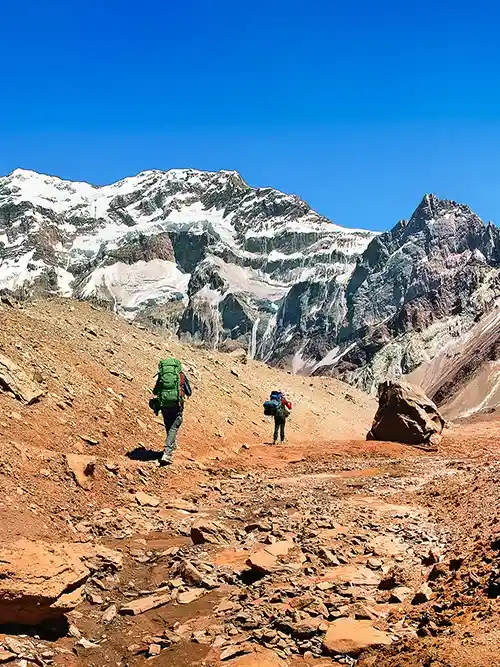
Here, we begin our great adventure on Aconcagua. After breakfast at 6 am, we’ll transfer to Horcones (2900m). After entering the park, we’ll hike for approximately 5 hours. Along the way, there is a lake where you will have your first view of the highest mountain in the Americas. At the end of the trek, we will arrive at Confluencia Camp. The rule is to hydrate well, have a good dinner, and rest.
Day 4 – Acclimatization at Confluencia (3300m)
After breakfast, we will take an acclimatization trek and return to camp in the afternoon. The rest of the day is for resting, good food, and hydration to be well-prepared for the next day.
Day 5 – From Confluencia to Plaza de Mulas (4350m)
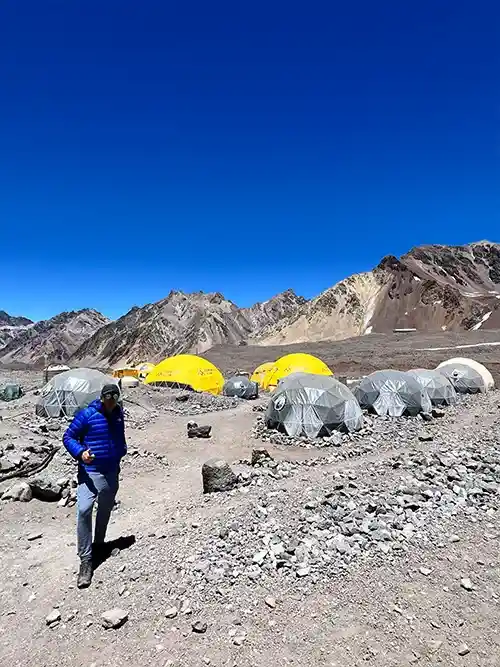
Right after breakfast, we will embark on a 17km hike to base camp. We’ll cross the river and walk a long flat section called Playa Ancha, followed by a continuous ascent to Cuesta Brava. We’ll arrive at Plaza de Mulas Camp in the afternoon. After settling into our tents, the rule remains the same as previous days: dinner, plenty of hydration, and rest.
Day 6 – Plaza de Mulas (4350m)
This day is dedicated to rest, which is necessary for our bodies to slowly adapt to this altitude, which is now over 4000 meters. After breakfast and checking everyone’s oxygen and heart rate levels, we may take short walks around the area to explore one of the largest base camps in the world.
Day 7 – From Plaza de Mulas to Canada (5050m)
After breakfast, we’ll take a 3km acclimatization hike up with gear. After reaching our destination and taking a short rest, we will return to our camp at Plaza de Mulas.
Day 8 – Plaza de Mulas (4350m)
This day is dedicated to rest, with the recommendation of only light walks around camp. Remember, this process is essential for your body to adjust to the altitude, helping you avoid problems later on. Drinking plenty of fluids is necessary for the body’s adaptation processes and helps prevent respiratory irritation due to the dry climate, which can cause coughing.
Day 9 – From Plaza de Mulas to Canada (5050m)
After breakfast, we will ascend to Camp 1, Canada, for our first overnight stay above base camp. We are now beyond the 5000-meter altitude mark. Good nutrition is essential for sufficient energy the next day, and the rule of constant hydration continues.
Day 10 – From Canada to Nido de Cóndores (5550m)
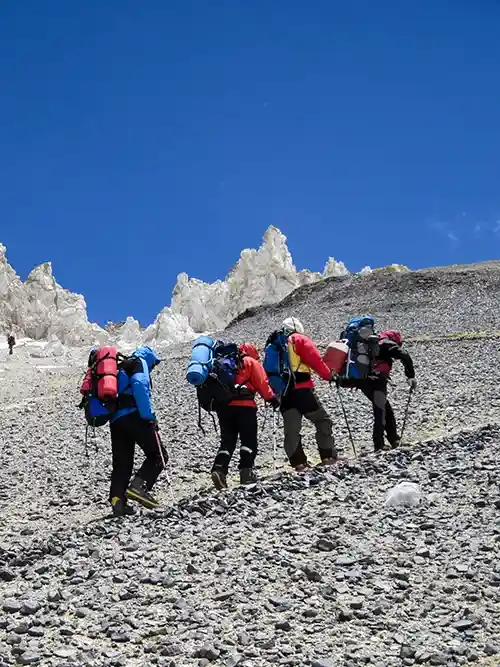
After breakfast, we’ll head to Camp 2, Nido de Cóndores. At this significant altitude, even those feeling strong should ascend slowly, allowing the body time to adjust to this new altitude.
Day 11 – Nido de Cóndores (5550m)
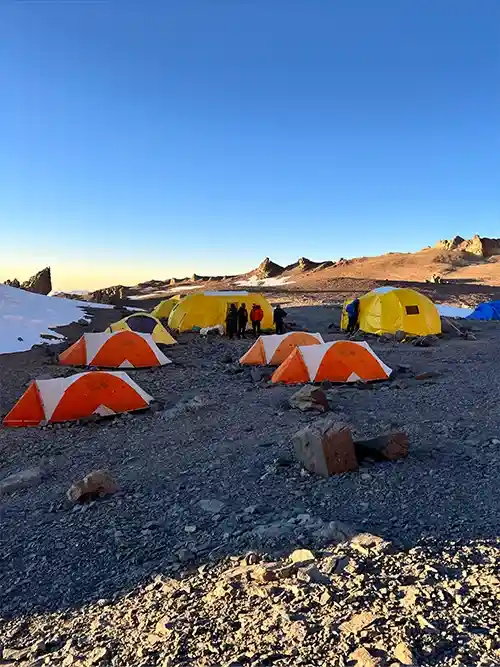
After breakfast, we’ll have a rest day as the summit day approaches. Intense hydration and good nutrition are the general rules. After dinner, we’ll check our vital signs for safety.
Day 12 – From Nido de Cóndores to Berlin (5950m)
After breakfast, we’ll climb to the highest camp on the normal route of Aconcagua, Berlin, at 5900 meters. Upon arrival, we will eat, hydrate, and rest in preparation for the much-anticipated summit attempt.
Day 13 – From Berlin to Summit (6962m) and Return to Berlin (5950m)
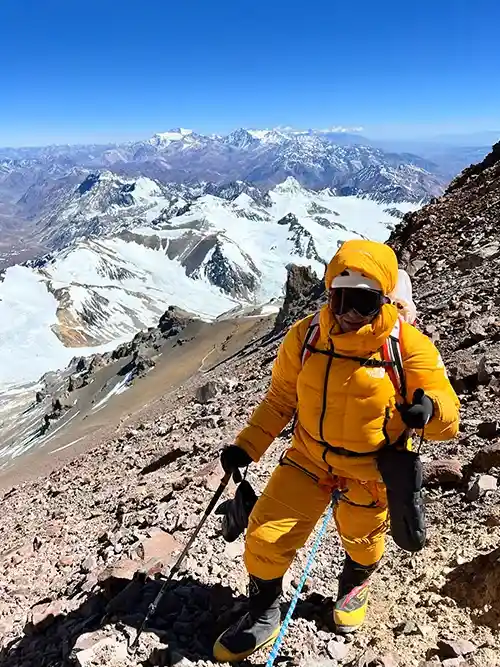
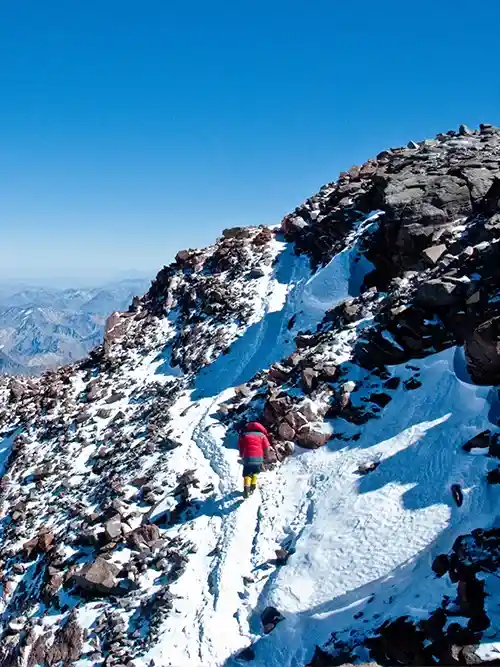
In the early morning, we will prepare for the long-awaited final summit push on the highest mountain in the Americas. It is approximately 3.5km to the summit, making a total of 7km for the ascent and descent. On average, this journey takes around 12 hours. After reaching the summit and celebrating with photos, we will descend to Berlin Camp.
Day 14 – From Nido de Cóndores to Plaza de Mulas (4350m)
After breakfast, we’ll start our descent to base camp.
Day 15 – Plaza de Mulas (4350m)
This day is reserved for rest, relaxation, and celebration of the courage it took to step out of our comfort zones and accomplish something so challenging and grand. We will also organize our gear for the journey back to Mendoza the following day.
Day 16 – From Plaza de Mulas to Confluencia, Horcones, and Mendoza
After breakfast, we’ll begin our return trek with mules carrying our equipment. It will be a long trek to the park exit, where a transfer will take us to Mendoza for the night, and we’ll celebrate our achievement once more.
Day 17 – Extra day due to mountain weather conditions
Extra day reserved in case of adverse weather conditions on the mountain.
Day 18 – Transfer to the airport and return flight
Transfer to the airport and flight back to your home country.
How do I know if I am physically fit to climb Aconcagua?
Although the ascent to the summit of Aconcagua does not involve technical sections (such as climbing areas), it is a long route with considerable elevation gain and altitude, so good physical preparation is necessary. It is recommended that participants have been physically active for a few years and have good muscular strength (to avoid discomfort at the end of each day’s trek and to reduce the chance of injury) and, especially, cardiovascular fitness, as this will be crucial for the long ascent in thin air.
Will we face extreme cold?
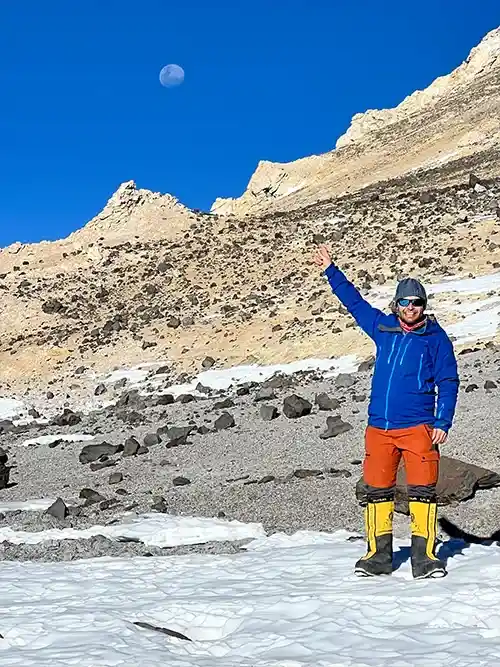
In Mendoza, January temperatures range from 17 degrees Celsius at night to 30 degrees during the day. However, at Aconcagua’s base camp, temperatures range from 10 degrees during the day to -5 degrees at night. Cold increases at the higher camps, with summit temperatures potentially reaching -15 degrees. You will find all the information about what to bring to handle the climate on the equipment list link.
What will be the logistics of our transfers?
Upon arrival at Mendoza airport, you will be met by a vehicle that will take you to the hotel. There will also be round-trip transfers to Aconcagua Provincial Park and a return transfer to the airport for the flight back to your home country.
What will the accommodations be like?
In Mendoza, we will stay at a 3-star hotel in a double room. During the expedition, we will stay in pre-set campsites upon arrival. Each tent will be shared by two people.
Can I choose a single room in Mendoza?
Yes, it is possible to have a single room, with an additional fee.
Can I leave part of my luggage in Mendoza?
Yes. Any luggage that will not be needed during the expedition will remain at the hotel in Mendoza, where we will stay again before the return flight to your home country.
Is there a menu for those with dietary restrictions?
If you have any dietary restrictions or allergies, please inform us in advance.
How does the acclimatization process work?
Our itinerary is designed to allow the acclimatization process to occur as naturally as possible, with extra nights at Confluencia and Plaza de Mulas. Exposure to altitude is gradual to minimize the impact on your body. Drinking plenty of water a few days before starting the expedition and throughout the trek is essential. Our bodies use water to facilitate the necessary transformations for altitude adaptation.
Will there be a local team to assist us?
Yes, in addition to the expedition organizer, Moeses Fiamoncini, we work with one local guide per 3 people. They will accompany us throughout the trek. Additionally, there is a team at the camps to set up the tents and prepare meals up to base camp.
How much weight will I carry during the trek?
From Penitentes to Plaza de Mulas, you will carry only a daypack with your essentials. This bag will contain: 2 liters of water, sunscreen, lip balm, a windbreaker (anorak), rain poncho, gloves, a fleece, and your preferred snacks. Your main pack will be transported by mules. From Plaza de Mulas to the summit, some people choose to hire a porter at an extra cost. For those who choose to carry their own packs, the typical weight is between 10 and 15 kilograms.
Are there facilities to take a shower?
At Plaza de Mulas (base camp), hot showers are available. Beyond this, at the higher camps, there are no showers. Personal hygiene is done using wet wipes.
Will there be electricity? How can I charge phones and cameras?
There is solar power available at Plaza de Mulas, where electronic devices can be charged.
Which airlines should I check for round-trip flights?
The airlines that operate flights from Brazil to Mendoza are Latam and Aerolíneas Argentinas.
How can I stay in touch with my family during the trip?
At the Plaza de Mulas camp, there is Wi-Fi, and some areas also have cell phone signal.
Can I decide to quit the expedition?
Yes, in an expedition involving high altitude, some people may not adapt and choose to return. In this case, a guide will accompany the return trip, but there will be an extra cost of $400.